Frequently asked questions about acupuncture
21 de março de 2021
Almost everyone has heard of Acupuncture – but do you understand how it works?
If you've always wanted to know, we're here to answer your questions!
There are many myths and misunderstandings about acupuncture, especially around what it really is and how it can help. Acupuncture is a simple, safe and effective health care technique that helps promote the body's ability to heal.
Let us answer some of your questions!
WHAT IS ACUPUNTURE?
Acupuncture is an ancient medicine that continues to gain popularity in the West. During treatment, very fine needles are inserted into specific points of the body. The stimulation of these acupuncture points affects the central and peripheral nervous system. Western medicine, from a scientific point of view, explains the effects of acupuncture by stimulating and releasing endogenous substances such as endorphins, neurotransmitters and hormones that will model the central and autonomous nervous system, promoting the balance of the body without the administration of any chemical substance.
WHAT CAN BE TREATED WITH CHINESE TRADITIONAL ACUPUNTURE AND MEDICIN?
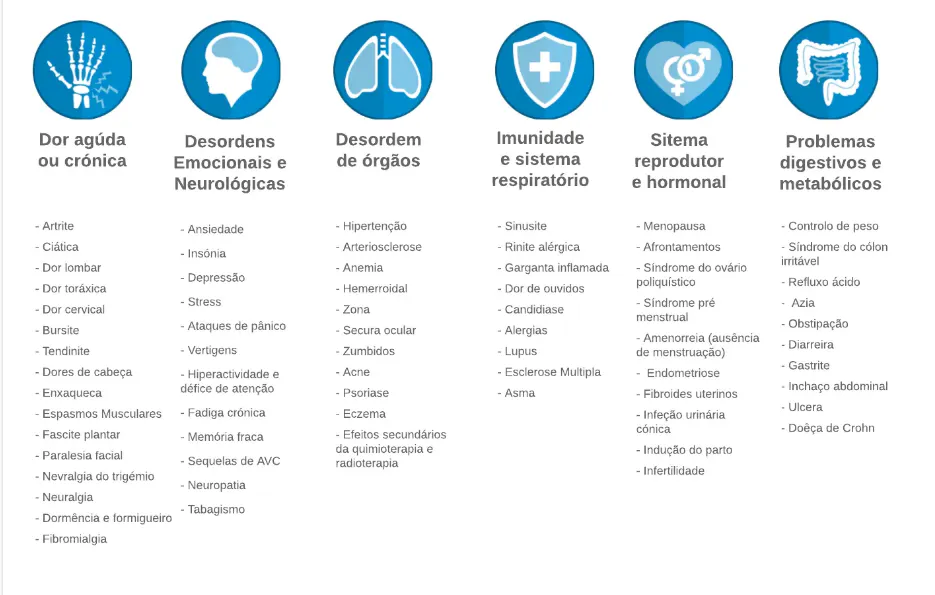
Traditional Chinese acupuncture and medicine can treat both simple (acute) and more complex (chronic) problems.
Then you can see a list of conditions that acupuncture and traditional Chinese medicine can help. (can access the World Health Organization listHere.)
THE PROVOCA PAIN AUPUNTURE?
This is the most common question about acupuncture, since many people associate needles with pain. Acupuncture needles have a thickness similar to that of a hair and are practically painless when inserted by a professional.
The specialist will insert the needle at the appropriate depth. You will usually experience a unique sensation that may vary between tingling, weight, heat, slight shock or even nothing. Each person's experience is different. If you feel any discomfort, tell your therapist to adjust the needles. All needles are sterile and disposable.
WHAT CAN I WAIT ON MY FIRST VISIT?
After asking different questions related to aspects of your life and clinical observation (pulse and language), one comes to a diagnosis and only then does one proceed to treatment. It can use several synergistic techniques such as moxabustion, suction cups, etc. At the end of the treatment, the strategy and recommendations will be presented in accordance with your specific case.
WHY DO YOU FEEL THE FULL AND SEE THE LANGUAGE?
Feeling the speed, endurance, strength and quality of the pulse helps to understand where your “motor” is working too much or not. In addition, the shape, color and lining of the tongue can help determine how fluids are moving in the body.
HOW LONG IS A TREATMENT?
Treatment usually takes between 45 and 60 minutes, depending on the needs of each one.
WHAT FREQUENCY OF TREATMENTS?
Treatments are done weekly, usually once, and sometimes twice or three times a week, depending on your specific treatment plan and progression. Once the condition has been controlled and is symptom-free, treatments are performed less frequently. Problems that have existed for a long time usually take more treatments to solve than those that have emerged more recently. Your treatment plan will be determined after the first visit and reassessed after each session.
HOW LONG BEFORE YOU SEE RESULTS? DO I NEED TO RECEIVE ACCUPUNTURE FOREVER?
Probably not, but that also depends on why you're being treated. For short-term problems, a short-term treatment plan can lead to the desired results. For chronic or long-standing problems, a maintenance plan would be studied to ensure that your body systems are functioning smoothly after the initial period of relief and change.
Acupuncture is also a great preventive medicine. Increasing blood flow means that your body is better able to heal itself and will increase the response of your immune system- helping you to fight better and prevent diseases.
THE SAME ACUPUNCTURE POINTS ARE USED FROM SESSION TO SESSION?
Decide points combinations depends on several different factors, such as your feedback on changes since your last visit, and subtle suggestions such as pulse variations.
Ultimately, combinations of acupuncture points are chosen to give each person the best treatment and faster resolution of their symptoms.
I FEEL TRAINER DURING TREATMENT – THAT AFTER I PASSED OUT COMPLETELY. Is that normal?
Yeah, that's fine. While our body reacts to the effects of treatment, the target area may feel tingling, warmth, lightness or, in rare circumstances, pain for a short time. These sensations are the result of the movement of blood and organic fluids and are a sign that the treatment is working. The body is reacting and changes are happening.
Using an analogy of a road with traffic, where pain is a traffic jam on a main road or highway. There is a lot of congestion in the same place, which causes rising temperature and poor air quality. As traffic (i.e. inflammation/pain) begins to decrease and move, cars (i.e., blood/organic fluids) begin to move. It is slow at first (i.e. tingling or pain), but eventually it moves smoothly along the road as it should (resumes to normal functioning and/or pain relief).